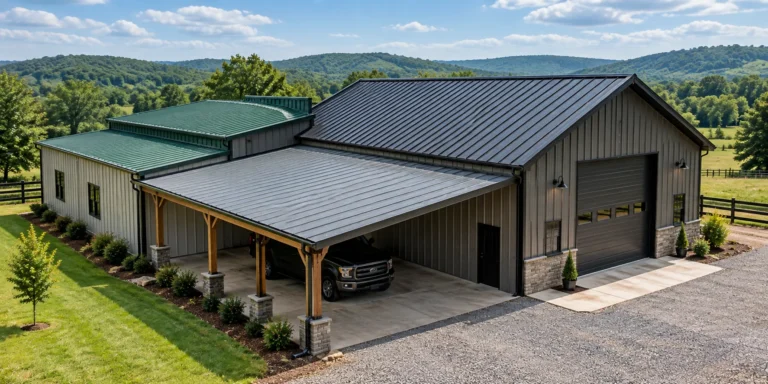
Most people consider roofing the final choice in a building project. Choose a colour, match it to the walls and move on. If all roofs were equal, that would be fine, but they are not equal and in Arkansas, the difference between a roof that works and a roof that is a problem becomes apparent sooner than in many other climates.
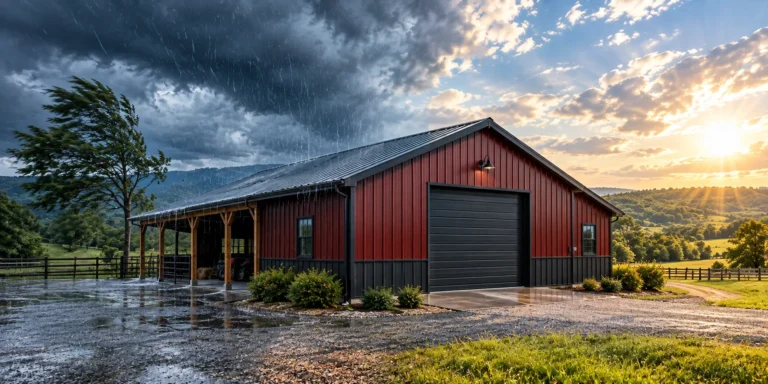
Fayetteville, Springdale, or Bentonville gets hammered with spring hail. Ice loads are an issue that shallow pitches and flat roofs struggle with, particularly in the Northwest Arkansas cities. Straight-line wind events are sufficiently frequent in the middle of the state around Conway and beyond, where installing panels is truly an engineering challenge, rather than a formality. The decisions made when selecting the right metal roof involve a few considerations that will impact building performance over the next 40-plus years and not only the day of installation.
Let’s take a look at how to make those decisions.
Panel Profile: The Choice That Affects Everything Else
The most important choice is the profile of the panel (rib shape and interlocking), since it will influence water shedding, installation method, structural performance, and the building’s appearance from 50 feet away.
Standing Seam: The ribs run vertically from ridge to eave, and the seams are locked together with no exposed fasteners. If there are no fasteners, there are no fastener holes, and if there are no fastener holes, there are fewer avenues for water to ultimately find its way in. Standing seam is the most weather-tight option and is more tolerant of thermal expansion than exposed fastener systems since the panels are not pinned against the siding. It’s more expensive than exposed fastener profiles, but is justified for buildings that require long-term performance and low maintenance.
Exposed Fastener Panels: Panels are fastened directly to the structure below with screws on the outside. It is quicker to install, cheaper, and a good performer as long as the fasteners are properly installed and the washers are in good condition. The maintenance consideration is that fastener washers can begin to get hardened and cracked over time, so small leaks begin. On a well-built structure with quality fasteners, this takes years to become an issue, but it’s a maintenance item that standing seam doesn’t have.
Corrugated Panels: The traditional agricultural profile. Available in a wide range of sizes, shapes, and capacities, they are an ideal solution for open structures, equipment storage and agricultural buildings where budget is more important than a finished appearance. Not appropriate for a barndominium living space or for a commercial building where appearance and long-term weather performance are the top priority.
Vertical vs. Horizontal Orientation
On enclosed buildings with a real roof pitch, vertical orientation, meaning the panel ribs run from the ridge down to the eave, is almost always the better choice in Arkansas. Water runs with the rib, not across it. Ice and debris move off the roof rather than sitting against a horizontal seam. Vertical panels also tend to perform better in high-wind events because the load transfers along the length of the panel rather than working against horizontal seams.
Horizontal orientation shows up more on walls than roofs, and even there the performance considerations are worth thinking through. On a wall that faces prevailing weather, vertical panels shed water more reliably. Horizontal panels are fine on sheltered sides or on structures where weather exposure is limited.
Where the Steel Actually Comes From
This is a section most roofing companies skip, and it matters more than it sounds.
Metal Dreams sources American coil and forms panels and trim in-state rather than pulling from an out-of-state warehouse or overseas supply chain. That closed loop has a few practical consequences for the person buying the roof.
- Material consistency. When coil comes from domestic mills and gets processed locally, what arrives on the job site matches what was ordered. No anonymous middle distributor deciding what grade makes it to an Arkansas job site.
- Lead times. During the pandemic, Arkansas contractors were waiting 11 weeks for panels sitting in out-of-state warehouses. One farm in Pine Bluff waited a full season for a roofing job. In-state fabrication collapses that. A panel going to Fayetteville doesn’t route through Texas or Missouri first.
- Tighter tolerances. People who have spent decades on a roof deck know which rib profiles cause problems in August heat, which trim details start leaking in year six, and which panels fight the installer at every seam. Metal Dreams was built by people with 25 years of hands-on roofing and siding installation behind them. That experience shapes the profiles they offer and the tolerances they hold.
- Recycled content and scrap value. The coil is made with a high percentage of recycled ferrous scrap. At the end of a 40 plus year service life, the panels have scrap value rather than a landfill fee. Asphalt shingles get torn off and buried every 15 to 20 years. Steel doesn’t work that way.
Paint System and Coating
The panel color you pick matters less than the paint system underneath it. Metal Dreams’ panels carry a 40-year signed paint warranty against chalk, fade, chip, and rust perforation. That’s not a marketing number. It reflects domestic coil with proper coating weight applied at the mill rather than a cheaper panel where the coating is the first thing to go.
On Color Selection: Darker colors absorb more heat, which is relevant in an Arkansas summer if the building is occupied or if you’re running temperature-sensitive equipment inside. Lighter colors and reflective finishes reduce thermal load on the interior. If insulation is part of the plan this matters less. If the building is uninsulated and you’re going to be working in it from May through September, roof color is worth thinking through rather than defaulting to whatever matches the trim.
Metal Dreams also offers high-definition wood-look panel prints for buildings where exterior appearance matters as much as performance. Barnwood, Rough Gray Cedar, Smooth Cedar, and Japanese Carbon-Charred Larch finishes are all available. The visual is real timber. The performance is 40-year warranted steel. Every finish is fire-resistant, pest-proof, and carries the same service life as a standard panel.
Pitch and Structure
Roof pitch affects drainage performance, interior headroom, and how the building handles snow and ice load. Steeper pitches shed water and ice faster. Shallower pitches work fine with good drainage design but leave less margin for error on seam performance in heavy rain.
Metal Dreams designs roof pitch around the application and the site. A barndominium with living space needs different pitch considerations than an open equipment shed. A building in a low-lying area near Conway or Pine Bluff where standing water is a seasonal reality gets designed differently than one on elevated ground in the Ozarks. The site conversation happens before the spec conversation for exactly this reason.
Insulation and the Roof System
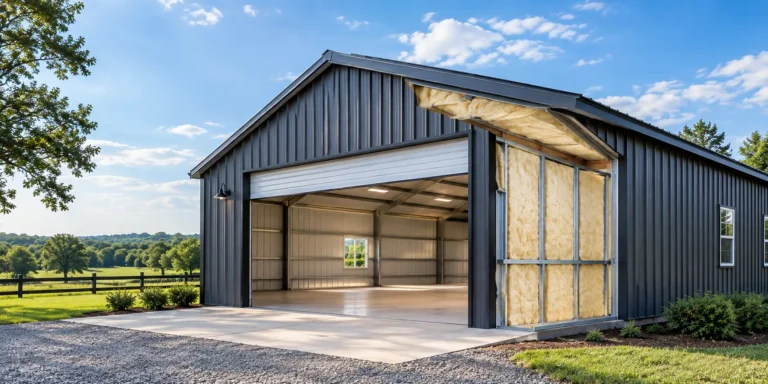
An uninsulated metal roof in Arkansas is a liability in two seasons. Summer turns the interior into a heat trap. Spring creates condensation on the underside of the panels that drips onto whatever’s stored or parked below.
A proper insulation system installed between the panels and the purlins addresses both problems. It also cuts down on the noise heavy rain makes on bare metal, which matters if the building is a workspace or a living space. The insulation decision is best made before the building goes up. Retrofitting it into a finished metal building is possible and more expensive than doing it right during construction.
Talk Through Your Roof Before You Finalize Anything
Metal Dreams fabricates panels in-state from American coil, which means they can hit specific profiles, colors, and trim details without routing through a multi-step distribution chain. If you’re matching an existing building or trying to hit a specific finish, send a sample and they’ll tell you straight whether they can match it.
Written estimates, no deposit required to start the conversation. Call Metal Dreams and work through what your building actually needs before you lock anything in.